Whiteout Survival F2P Guide 2026: Progress Faster Without Spending
A dedicated Whiteout Survival F2P guide: gem-saving priorities, the Lucky Wheel and VIP breakpoints worth targeting, which heroes give free accounts the best return, and how to pace event participation without spending.
Whiteout Survival is fully playable, and genuinely competitive, without spending a dollar, but "free-to-play" and "no strategy" are not the same thing. F2P accounts that thrive treat gems, materials, and hero investment as a budget to manage deliberately, not a pile to spend on whatever looks exciting that day. This guide covers that budget in detail: where your free gems actually come from, what to spend them on and in what order, which heroes give a free account the best long-term return, how to pace chief gear on a free material income, and the one purchase decision most F2P-minded guides treat as a genuine exception.
Quick Answer: The F2P Priority Framework
| Priority | What to do | Why it matters |
|---|---|---|
| 1 | Stack free gems from daily sources instead of spending reactively | Random spending on regular hero recruitment has notoriously poor odds; saved gems go much further on planned targets |
| 2 | Spend gems on the second construction queue during early-to-mid game | A near-permanent value multiplier on every build and research queue you'll ever run |
| 3 | Save the rest for Lucky Wheel milestones, not random spins | Milestone rewards at fixed spin counts are worth far more per gem than spinning without a target |
| 4 | Push VIP to level 6, then level 7, and stop pushing after that | These two levels unlock a second march queue and a daily Mythic-tier hero shard; VIP 8 and beyond cost sharply more for less |
| 5 | Build Flint, invest in Mia, and prioritize Blanchette if she's reachable | All three are heroes this site's own research and hero tier list independently flag as strong, genuinely accessible F2P returns |
| 6 | Treat event participation as your main material source for chief gear, not a side activity | Events, not shops, are where a free account's Hardened Alloy, Polishing Solution, and shards actually come from |
| 7 | If you spend anything at all, evaluate the Growth Fund early and stop there | It's the one purchase most F2P-adjacent guides treat as a genuine exception, and only if bought before your Furnace outgrows its value window |
The sections below explain the reasoning behind each of these, along with the numbers that back them up.
How Far Can an F2P Account Actually Get
Our Pillar guide already establishes that Whiteout Survival is playable and competitive as F2P. What that summary doesn't cover is what "competitive" actually looks like in practice. F2P accounts that play consistently, join an active alliance, and follow the priorities in this guide can reach genuinely useful mid-tier standing: fully functional in SvS preparation and battle phases, capable of contributing meaningfully to Bear Trap and alliance events, and able to build a legitimate five-hero core without ever opening a paid recruitment pack.
What F2P accounts generally cannot do is compete for individual top ranks in whale-dominated leaderboards, such as spending-based competitions where paid gem purchases directly determine placement. That distinction matters for expectations: a free account's goal should be steady account-wide strength and reliable alliance contribution, not chasing the very top of every individual ranking board. Milestone-tier rewards, which most recurring events (including Hall of Heroes, as our Pillar guide already notes) offer regardless of final rank, are where F2P value actually accumulates.
Where Your Free Gems Come From
Gems are the resource every F2P decision in this guide revolves around, and they come from a wider spread of sources than most new players realize.
| Source | Type |
|---|---|
| Daily missions and login rewards | Guaranteed, small, compounds over time |
| Achievements | One-time, often overlooked |
| Alliance gifts and chests | Recurring, tied to alliance activity |
| Arena rankings | Recurring, tied to weekly performance |
| Working Overtime, War Preparation, and Trusted Chief events | Small individual events cited across multiple F2P guides as offering outsized gem rewards, up to roughly 50,000 gems each per one detailed source |
| Bear Trap and other personal-reward events | Recurring, scales with participation effort rather than spending |
Several F2P-focused guides estimate that consistent daily play across these sources can generate on the order of 100,000 or more gems a month. Treat that as a rough estimate rather than a guaranteed number, since it depends heavily on alliance activity and how many events happen to run in a given month, but it illustrates why saving toward planned targets works better than spending as gems arrive.
Gem Spending Priorities for F2P
Once gems accumulate, where you put them matters more than how much you have. The priority order below is consistent across the F2P guides checked for this article.
| Priority | Spend on | Reasoning |
|---|---|---|
| 1 | Second construction queue | Keeps two builders working simultaneously during early-to-mid game rather than one queue sitting idle; one detailed source cites roughly 1,000 gems for two days of activation, making it cheap relative to the time it saves |
| 2 | Lucky Wheel milestones | Fixed milestone rewards at specific spin counts return far more value per gem than unplanned spins; covered in detail below |
| 3 | VIP at meaningful breakpoints | Only worth spending gems on VIP EXP when the next level unlocks a real account benefit, not incrementally |
| 4 | Hall of Heroes, targeted only | Spend Marks of Valor here only when chasing a specific hero's shards or widgets, and calculate the full cost first rather than buying reactively |
| 5 | Utility reserve | Keep a small emergency reserve for Advanced Teleports, Peace Shields, or finishing a genuinely valuable event milestone at the last minute |
What to avoid is just as important as what to prioritize: regular hero recruitment pulls are commonly cited across F2P guides as having very poor legendary and epic odds, and spending saved gems there is generally treated as one of the least efficient uses of a limited F2P gem budget compared to the planned targets above.
The Lucky Wheel: Your Most Reliable F2P Investment
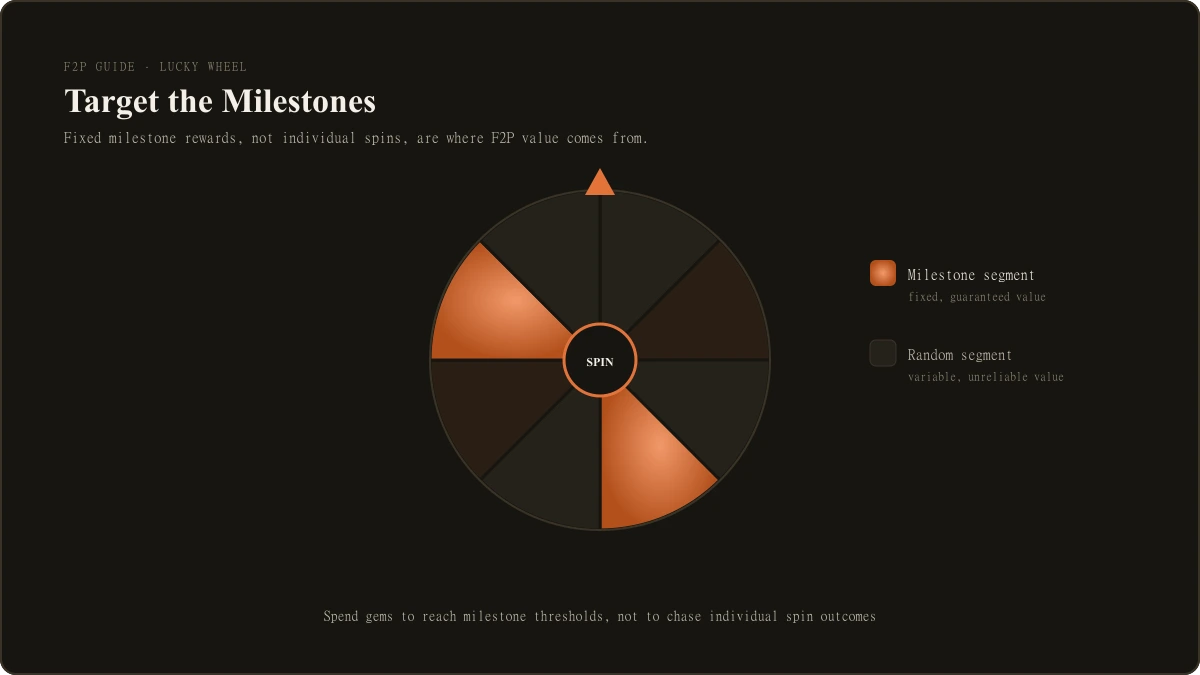
The Lucky Wheel is where F2P gem-saving pays off most predictably, because its rewards are structured around fixed milestones rather than random luck.
| Spins reached | Cumulative shards |
|---|---|
| 5 | 5 |
| 15 | 15 |
| 35 | 35 |
| 70 | 65 |
| 120 | 115 |
A single spin costs roughly 1,500 gems, and a 10-spin bundle costs roughly 13,500 gems (including a small bonus spin). Reaching the 120-spin milestone is the commonly recommended F2P target, since it guarantees 115 shards on top of whatever bonus shards land along the way, and going meaningfully past 120 spins is generally considered wasteful for an F2P budget. Free spin tickets from daily event days and SvS participation chip away at that total before you spend a single gem, so the practical gem cost to reach 120 is somewhat lower than the raw spin math suggests.
This is also exactly how Flint, covered below, becomes buildable without paid packs: he's the Lucky Wheel hero for his generation, so saved gems convert directly into his shards on a predictable schedule.
VIP: How Far to Push It as F2P
VIP levels provide permanent, passive bonuses to build speed, training speed, and resource production, plus unlock thresholds like extra march queues and daily hero shards. For F2P accounts, two levels matter far more than the rest.
| VIP level | What it unlocks | F2P relevance |
|---|---|---|
| 6 | Extra march queue | Improves gathering, Beast hunting, Bear Trap participation, and general map activity without needing another hero slot |
| 7 | Daily hero shard drop, plus continued construction speed gains | Widely cited as the strongest realistic long-term F2P target; over a year of consistent play, the daily shard drop alone adds up to roughly 365 shards |
| 8 and beyond | Steep XP jumps (one source cites roughly 160,000 cumulative XP at VIP 7 versus roughly 260,000 at VIP 8) with diminishing marginal benefit | Not a priority for F2P accounts; VIP 12 specifically is not worth treating as an urgent goal |
The practical approach: maintain daily login streaks (which alone can provide meaningful VIP points), spend any spare Alliance Shop currency on VIP points opportunistically, and stop actively chasing VIP progress once you're past level 7 unless a specific breakpoint further out genuinely matters to your account.
Which Heroes Give F2P Accounts the Best Long-Term Return
Naming specific heroes carries risk, since multiple lower-quality sources checked across this site's Whiteout Survival coverage have misstated troop classes in the past. The three heroes below were verified against this site's own heroes guide and hero tier list before being included here, not taken on faith from a single new source.
| Hero | Class / generation | Why it's a strong F2P pick |
|---|---|---|
| Flint | Infantry, Generation 2 | He's the Lucky Wheel hero for his generation, so saved gems build him on a predictable schedule instead of relying on ranking rewards or paid packs. He's a common first Legendary Infantry upgrade for accounts that started with the beginner guide's starter tank |
| Mia | Lancer, Generation 3 | Her percentage-based skill kit keeps scaling as your account's base stats grow, which our own hero tier list independently cites as the reason she remains one of the longest-lasting heroes in the game despite her age |
| Blanchette | Marksman, Generation 10 | Our own hero tier list already places her in S tier and specifically describes her as "widely cited as the top free-to-play damage dealer," making her worth prioritizing whenever she becomes available to your account |
If you haven't built a starter core yet, our beginner guide covers the specific F2P starter five (Natalia, Sergey, Molly, Jessie, and a support hero) that these three heroes are meant to build on top of, not replace outright. Once your starter core is functional, Flint and Mia are reasonable next targets precisely because they don't depend on spending, and Blanchette is worth prioritizing the moment she's reachable given her explicit F2P framing in our own tier list. For the full current-meta ranking these three sit within, and for other strong picks depending on what generations your server has unlocked, see the complete hero tier list.
Chief Gear Priorities on a Free Material Budget
Our chief gear guide already notes that F2P accounts follow the same upgrade order and set-bonus math as spending accounts, just on a slower material timeline. What that article doesn't cover in depth is exactly where a free account's materials should come from and how to pace around that reality.
The core adjustment for a free budget comes down to three habits:
- Treat events as your material source, not shops. Bear Trap, Crazy Joe, the Alliance Championship Shop, and Frostfire Mine are the dependable free sources for Hardened Alloy, Polishing Solution, and Design Plans described in the chief gear guide. Skipping these events to save time costs materials you can't easily replace another way.
- Resist rushing a single piece just because one material is abundant. A surplus of Hardened Alloy doesn't mean you should push one slot ahead of schedule if Polishing Solution is lagging behind; uneven material stockpiles are a common trap that breaks the balanced-upgrade rule the chief gear guide is built around.
- Save Lunar Amber deliberately. It's the scarcest material and only matters once gear is forging-ready for Legendary quality, so there's no reason to spend it early even if an event happens to offer some.
Because material income scales with event participation rather than Furnace level, a consistent F2P account that never misses an event often keeps pace with a light spender who participates inconsistently. Materials, unlike gems, don't have a reliable direct-purchase shortcut for most F2P budgets, which is exactly why event attendance functions as this account type's real gear-progression engine.
Event Participation Strategy for F2P
Recurring events are not optional for an F2P account, they're the primary income source for gems, materials, and hero shards that a free account can't get anywhere else. A few specific priorities matter beyond the general event coverage our Pillar guide already summarizes, and beyond what our dedicated events guide covers in depth:
- Small individual events return outsized value. Working Overtime, War Preparation, and Trusted Chief are consistently cited as smaller-scale events that still return meaningful gem totals, and they're easy to underrate because they don't feel as significant as Bear Trap or SvS.
- Chase milestone tiers, not leaderboard rank, in spending-adjacent competitions. Some recurring competitions are effectively spending leaderboards where top placement depends on paid gem purchases. F2P accounts should complete the point thresholds needed for milestone rewards and stop there, rather than trying to compete for a top rank that isn't realistically reachable without spending.
- Don't burn speedups outside of events. Saved construction and research speedups are worth noticeably more when used during a speedup-focused event that multiplies their effect, so holding them until then instead of spending them reactively is a small habit with a real cumulative payoff.
Should You Ever Spend Anything At All
Staying completely F2P is a fully valid choice, and nothing in this guide requires spending. That said, most F2P-adjacent guides treat one purchase as a genuine exception worth evaluating: the Growth Fund pack, which our beginner guide already introduces at a beginner level. Here's the deeper evaluation framework for a chief specifically trying to stay as close to free as possible.
The Growth Fund pays out gradually as your Furnace levels up, so its value depends entirely on how much of that reward path you'll realistically use. Before considering it, ask honestly:
- How far is your account from the milestones the pack rewards?
- How much of the reward path can you still realistically claim?
- Would waiting reduce its value, since it's time-gated to Furnace progression rather than usable all at once?
The general guidance across the sources checked is to evaluate it before your Furnace passes level 10, since much of its value window closes as your account outgrows the pack's early milestones. Beyond the Growth Fund, most other packs are aimed at accounts already spending regularly and don't fit a genuinely F2P-focused strategy, which is why this guide treats it as the one exception rather than a gateway to broader spending.
Common F2P Mistakes to Avoid
| Mistake | Why it costs you | The fix |
|---|---|---|
| Spending gems on regular hero recruitment pulls | Legendary and epic odds from standard recruitment are widely cited as very poor, wasting gems that could hit a planned Lucky Wheel milestone instead | Save gems for Lucky Wheel milestones and targeted Hall of Heroes purchases, not open-ended recruitment |
| Chasing VIP levels past 7 | XP costs climb sharply for VIP 8 and beyond while the marginal benefit shrinks | Stop active VIP pushing once you've cleared VIP 7 unless a specific later breakpoint matters to your account |
| Skipping small events because the rewards look minor | Working Overtime, War Preparation, and Trusted Chief individually look small but compound into a meaningful share of monthly gem income | Treat every recurring event, not just the flashy ones, as part of your income routine |
| Rushing one chief gear piece because one material is abundant | Breaks the balanced-upgrade rule and delays your 3-piece and 6-piece set bonuses | Keep all six gear pieces within a tier or two of each other, per the chief gear guide's upgrade order |
| Trying to outrank whales in spending-based competitions | Paid gem purchases directly influence leaderboard placement in some competitions, making top rank unrealistic for F2P | Target milestone-tier rewards instead of chasing leaderboard position |
Where Sources Disagree
Most of the mechanics in this article were consistent across the sources checked, with one specific detail worth flagging rather than quietly resolving.
VIP breakpoint for Mythic-tier daily shards. One detailed source states that VIP 7 already unlocks a daily Mythic-tier hero shard. A second source instead frames VIP 7 as granting a daily general hero shard, with the shard type specifically upgrading to Mythic-tier only at VIP 8. Both sources agree VIP 7 is the primary realistic F2P target and VIP 8 requires substantially more XP for comparatively less benefit, so this article's guidance (push to VIP 7, then stop actively chasing further levels) holds either way. The exact level at which the daily shard becomes Mythic-tier specifically is not fully reconciled between the two sources, so check your own account's VIP rewards screen once you're near that threshold rather than assuming either figure.
What to Read Next
- New or returning chiefs who haven't built a starter core yet should start with the beginner guide.
- For the mechanics behind hero leveling, star promotion, and widgets referenced above, read the heroes guide.
- For the current full ranking Flint, Mia, and Blanchette sit within, check the hero tier list.
- Once your material income is consistent, follow the complete upgrade order in the chief gear guide.
- For the full picture of how heroes, progression, gear, and events connect, start from the complete Whiteout Survival guide.

Ethan Cole is the Guides Editor at LootVora, covering game progression, builds, tier lists, resources, and strategy.