Whiteout Survival State of Power (SvS) Guide: Preparation, Matchmaking & Battle Tips
A complete Whiteout Survival State of Power guide: eligibility, matchmaking, the full phase-by-phase timeline, preparation point sources, and battle-phase teleport and rally tactics.

State of Power, usually shortened to SvS, is the recurring event that decides more of a state's standing than anything else in Whiteout Survival. Our events guide already covers where SvS fits among the game's full event calendar and why it sits at the top of the priority list. This guide picks up exactly where that one stops: matchmaking, the full phase-by-phase timeline, exactly what earns points during preparation, and how to actually fight once the battle phase opens.
Quick Answer: The Full SvS Timeline
SvS runs as one continuous roughly 10-day cycle, built from four distinct phases. Here's what happens in each one:
| Phase | Duration | What happens |
|---|---|---|
| Matchmaking | 2 days | Your state is paired against an opponent of similar strength; the opponent's identity reveals on day 2 so both sides can start scouting |
| Preparation | About 5 to 5.5 scoring days (see note below) | Daily themed tasks earn personal, alliance, and state points; the higher-scoring state gets a real advantage heading into the battle phase |
| Battle | 12 hours (commonly cited as Saturday, 10:00 to 22:00 UTC) | Cross-state teleports open, players attack enemy cities and troops, and a roughly 5-hour Sunfire Castle Battle runs inside that window |
| Field Triage | About 2 days | Lost troops recover through a state-wide healing buff, Rebirth Tomes, and optional gem-bought potions |
Sources checked for this guide differ slightly on the exact Preparation Phase length (two sources give 5.5 days, one rounds to 5, one states 6), which is covered in full under "Where Sources Disagree" below. The overall shape (a multi-day preparation window followed by a single intense battle day) is consistent across every source.
Eligibility: What Furnace Level You Need
| Furnace level | What you can do in SvS |
|---|---|
| Below 16 | Score points during the Preparation Phase and defend your own city during the Battle Phase, but cannot cross into enemy territory |
| 16 and above | Full participation, including cross-state teleporting and attacking during the Battle Phase |
That Furnace 16 threshold for battle-phase attacking is consistent across multiple sources checked for this guide, matching the "commonly cited around 16+" figure already noted in our events guide. One source adds finer detail worth flagging as single-sourced rather than confirmed: it describes a tiered state-point contribution scale (Fire Crystal 4 and above contributing 100% of a chief's points toward the state total, Fire Crystal 2 to 3 contributing 50%, and Furnace 16 up through Fire Crystal 1 contributing 0% toward the state score despite still being able to participate personally). That same source also states a state needs to be roughly 12 weeks old, around day 80, before it qualifies for SvS matchmaking at all, a detail not found in any other source checked. Treat both of these as commonly cited rather than universally confirmed, and check your own state's in-game event listing for confirmation.
Matchmaking Phase: How States Get Paired
Matchmaking runs for 2 days at the start of every SvS cycle. On day 1, the system evaluates and pairs your state against an opponent based on several factors cited consistently across sources: the combined troop power of each state's top 100 chiefs, historical SvS win records, and overall state activity level. By day 2, the opponent's identity is revealed, which is when serious preparation planning and scouting typically starts inside an alliance.
Because troop power of top chiefs feeds directly into this calculation, individual account strength, including chief gear, genuinely matters beyond your own personal SvS performance. See how chief gear factors into SvS below.
Preparation Phase: Daily Scoring Themes
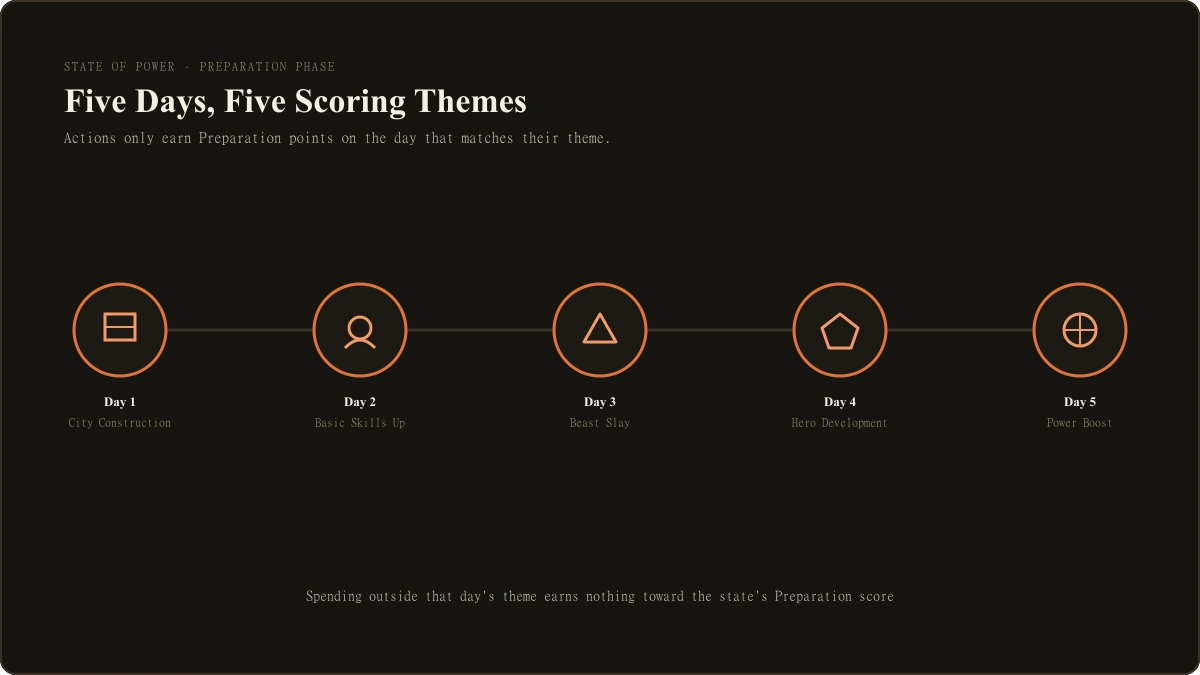
This is the phase most players underestimate. Every action you take during Preparation only earns points if it matches that specific day's scoring theme, which means spending resources on the wrong day wastes them entirely. The five daily themes, consistent across the sources checked for this guide:
| Day | Theme | What scores points |
|---|---|---|
| 1 | City Construction | Building upgrades, Fire Crystal upgrades, construction speedups |
| 2 | Basic Skills Up | Hero shard use, research completion, Lucky Wheel spins |
| 3 | Beast Slay | Rallying and defeating beasts, Polar Terror hunts, pet refinement |
| 4 | Hero Development | Troop training, hero gear upgrades, hero promotions |
| 5 | Power Boost | Chief gear upgrades, remaining speedups, and a broader catch-all across earlier categories |
The practical habit every source agrees on: stop burning speedups, Fire Crystals, and other consumables casually in the weeks leading up to SvS. Anything spent early is unavailable when the matching scoring day actually opens. A chief who banks two weeks of construction speedups for Day 1, rather than using them as they arrive, walks into Preparation with a meaningfully larger score than one who didn't plan ahead.
How Much Specific Actions Are Worth
One detailed source breaks down approximate point values for individual actions during Preparation. These figures come from a single guide and were not independently confirmed with the same specificity by a second source, so treat them as illustrative rather than official:
| Action | Approximate points (single-sourced) | Scoring day |
|---|---|---|
| Fire Crystal building upgrade | Roughly 2,000 points each | Day 1 |
| Construction speedup burned | Roughly 30 points per minute | Day 1 |
| Mythic hero shard used | Roughly 3,040 points per shard | Day 2 |
| Level 26 to 30 beast kill | Roughly 12,000 points per kill | Day 3 |
That same source frames a single high-level beast kill as worth roughly 400 minutes of speedup burning in raw point value, which is why coordinated alliance beast rallies on Day 3 are consistently cited as one of the highest-value activities in the entire Preparation Phase, provided your alliance can actually organize and clear one.
Battle Phase: Teleporting, Rallies, and the Sunfire Castle Battle
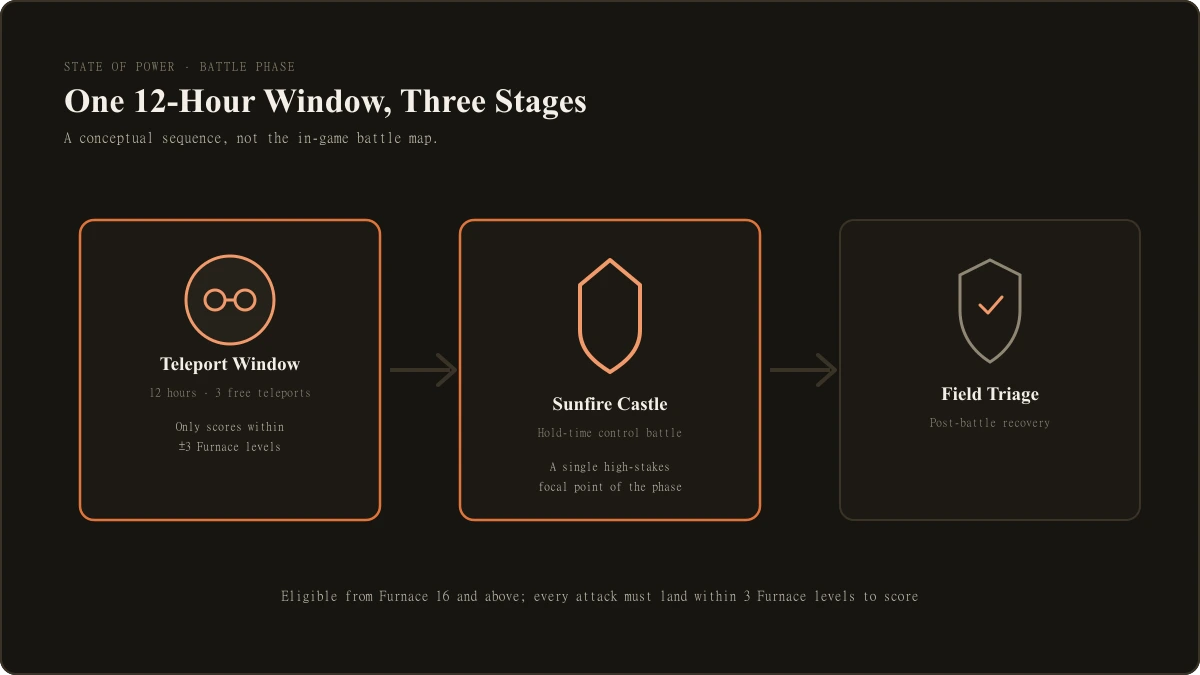
The Battle Phase is a single 12-hour window, commonly cited as running Saturday from 10:00 to 22:00 UTC, and it's structurally different from anything else covered in the Preparation Phase.
Once the cross-state portal opens, every eligible chief (Furnace 16 and above) receives 3 free teleports into the opposing state's territory. Two mechanics govern whether an attack actually scores points:
- The plus-or-minus-3 Furnace Level rule. You only earn points from troops killed or lost against opposing chiefs within 3 Furnace levels of your own. Attacking a target too far outside that range doesn't score, regardless of the outcome.
- Rally captain eligibility for joiners. If you're joining someone else's rally rather than leading it, it's the rally captain's Furnace level, not your own, that determines whether the attack falls inside that plus-or-minus-3 window. This is the SvS-specific application of the rally captain versus joiner mechanic already covered in full in our best formation guide: review that article for how captain and joiner hero slots actually work before committing your heroes to an SvS rally.
Teleporting carries real risk. Reinforcements left behind at your home city stay there when you teleport away, so if you commit troops to an attack march, your own city's defenses depend on whatever's still garrisoned, or on alliance mates covering for you. One source also notes that attacking or scouting an opponent drops your own shield and locks it for 30 minutes, while reinforcing an ally's city does not carry that same shield penalty, a detail worth confirming on your own account since it wasn't independently corroborated by a second source.
The Sunfire Castle Battle
Within the 12-hour Battle Phase window, a separate objective runs for roughly 5 hours: the Sunfire Castle Battle, fought inside whichever state lost the Preparation Phase, giving the Preparation winner a genuine home-field advantage. Alliances fight to control the castle, and the alliance that controls it wins the right to appoint the new Supreme President and a set of ministers who govern both states for roughly the next two weeks, until the following SvS cycle. Sources checked for this guide agree on the shape of that win condition (hold the castle consecutively, or hold it longest across the window) but disagree on the exact numbers, covered below in "Where Sources Disagree."
Field Triage: Recovering After Battle
The roughly 2-day Field Triage phase that closes out the cycle exists for one purpose: getting your troops back after a demanding Battle Phase. A state-wide healing speed buff runs for the full window, and recovery stacks from a few sources: a base automatic recovery percentage, Rebirth Tomes shared between alliance mates (each adding a small recovery boost, with a capped total), and optional gem-purchased revival potions for chiefs who want to close the gap faster. This is also the point in the cycle where it's worth checking your hospital capacity against how many troops you actually sent out, since losses beyond what your hospital can hold don't get the same recovery treatment.
Alliance Coordination: How States Actually Win
None of the mechanics above matter much without alliance-level coordination, and every source checked for this guide emphasizes the same core habits:
- Communicate the day's theme before anyone spends anything. A member who burns speedups on Day 3 instead of Day 1 has wasted resources the alliance's total score needed.
- Assign attack and defense roles ahead of the Battle Phase, rather than deciding in the moment who's teleporting out and who's holding the city.
- Plan Day 3 beast rallies deliberately. Given how much a single high-level beast kill is worth relative to other actions, an organized rally captain and a full squad of joiners on the right beast target is one of the highest-value coordinated plays in the whole cycle.
- Cover for teleporting members. Since teleporting away doesn't bring your home reinforcements with you, an alliance that rotates defensive coverage protects members who are actively attacking.
- Treat internal competition as secondary to state-wide coordination. Sources consistently frame SvS as a state-versus-state contest first; alliances that share targets and information rather than compete with each other internally tend to come out ahead.
Rewards: What You're Actually Playing For
| Reward tier | What you earn |
|---|---|
| Top 150 (Preparation Phase personal ranking) | Current-season Mythic hero shards |
| Top 50 (Battle Phase personal ranking) | Exclusive city skins |
| Daily milestone thresholds | State Medals, redeemable through the SvS shop, capped per cycle |
| Alliance rankings, daily and total | Speedups, resources, Sunfire Tokens, and rare materials |
| Winning state | Sunfire Tokens, exclusive shop access, and ministry seats in the losing state |
| Sunfire Castle winner | The Supreme President title, governing both states for roughly two weeks |
Sunfire Tokens earned across both Preparation and Battle phases redeem through a dedicated SvS shop, and both the personal and alliance reward tiers are worth planning around rather than treating SvS purely as a leaderboard chase. Milestone rewards, available regardless of final rank, are where most players actually capture value, the same principle our events guide applies to the broader event calendar.
Common SvS Mistakes
| Mistake | Why it costs you | The fix |
|---|---|---|
| Spending on a task before checking that day's theme | Off-theme actions don't score, wasting resources that could have counted elsewhere | Check the day's theme first, then match your spending to it |
| Burning speedups and Fire Crystals in the weeks before SvS out of habit | Nothing left to spend during the day that actually rewards it | Stop casual speedup use roughly two weeks out and bank everything for the event |
| Teleporting into enemy territory without covering your own city | Reinforcements left at home don't travel with you, leaving your city exposed while you're away | Coordinate defensive coverage with alliance mates before committing to an attack teleport |
| Joining a rally without checking the captain's Furnace level | A joiner's attack only scores if the rally captain falls inside the plus-or-minus-3 Furnace Level rule, regardless of your own level | Confirm the rally captain's Furnace level before joining, and review our best formation guide's captain-versus-joiner mechanic beforehand |
| Ignoring the Preparation Phase because the Battle Phase feels more exciting | The Preparation winner gets the Sunfire Castle Battle fought in the losing state's territory, a real structural advantage | Treat Preparation Phase point totals as seriously as battle performance |
How Chief Gear and Formations Factor Into SvS
SvS doesn't run on a separate power system from the rest of the game. Matchmaking weighs the combined troop power of a state's top chiefs, and chief gear is one of the more direct ways to raise your own contribution to that number, on top of scoring points outright on Preparation Day 5. Our chief gear guide covers the full upgrade order for getting there. On the formation side, everything about how you build a rally captain squad or a joiner's first-slot hero, covered in full in our best formation guide, applies directly to Battle Phase teleports and rallies. Neither system is unique to SvS, but SvS is where both get tested at once.
Where Sources Disagree
Most of the mechanics in this guide were consistent across the sources checked, with a few points worth flagging rather than quietly resolving.
Preparation Phase length. Two sources place the Preparation Phase at roughly 5.5 days, running Monday through Saturday 10:00 UTC with 5 distinct scoring days plus a partial closing window. One source rounds this to a flat 5-day phase. A fourth source states the phase runs 6 days. The 5-day scoring structure (the actual daily themes) is consistent across every source regardless of how the total phase length gets described, so this article uses "about 5 to 5.5 scoring days" rather than picking one figure as definitively correct.
Sunfire Castle Battle hold-time condition. One source describes the win condition as holding the castle for 3 consecutive hours, or the longest cumulative hold across a stated 6-hour window. Another source, whose 5-hour castle-battle window (12:00 to 17:00 UTC) is independently corroborated by a third source's timing, instead states the threshold is 2.5 consecutive hours. Since the underlying window length itself is better corroborated at 5 hours, the 2.5-hour figure is more internally consistent, but this article presents both numbers rather than asserting one as confirmed, since neither source is clearly more authoritative than the other on this specific detail.
Eligibility granularity and state-age requirement. The base Furnace 16 threshold for battle-phase attacking is corroborated across multiple sources. The finer-grained state-point contribution tiers (Fire Crystal 4+, Fire Crystal 2-3, and the 0% range) and the roughly 12-week, day-80 state-age requirement for SvS eligibility each trace to a single source and were not found or contradicted elsewhere. Both are presented above as commonly cited rather than confirmed.
Specific Preparation Phase point values. The exact point figures for actions like Fire Crystal upgrades, hero shard use, and beast kills all trace to one detailed source. The relative pattern they describe, that high-level beast kills return outsized value for the coordination required, is plausible and consistent with the broader emphasis on Day 3 beast rallies across sources, but the specific numbers themselves are single-sourced and should be treated as illustrative.
What to Read Next
- For the full recurring-event calendar and how SvS fits into overall event priority, read our events guide.
- For the rally captain versus joiner mechanic and troop-class counters referenced throughout the Battle Phase section, read our best formation guide.
- For the full chief gear upgrade order that feeds directly into SvS matchmaking strength, read our chief gear guide.
- Free-to-play chiefs managing a limited resource budget around SvS should read our dedicated F2P progression guide.
- For the full picture of how heroes, progression, gear, and events all connect, start from our complete Whiteout Survival guide.

Ethan Cole is the Guides Editor at LootVora, covering game progression, builds, tier lists, resources, and strategy.